The popularity of Real Estate Investment Trusts (REITs) is on the rise globally and Ghana is no exception. This is driven by investors’ need for a more financially flexible way to invest in various segments of the real estate market. In Ghana, investors are also turning to REITs instead of traditional investment products following Ghana’s first sovereign debt default in 2022 that has exposed the risks of investing in government-backed securities. The National Pensions Regulatory Authority (NPRA) for instance now considers REITs as a permissible investment for pension funds, according to its Guidelines on Investment of Pension Scheme Funds.
This article explains how REITs work, explores the benefits and risks of investing in them, and highlights how they are regulated in Ghana.
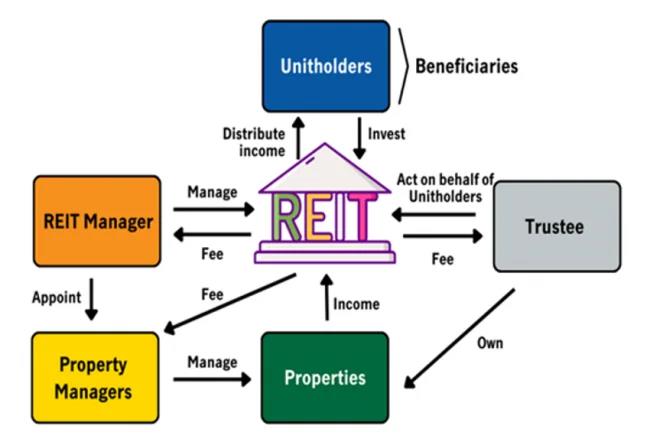
A REIT is a publicly traded company that owns, operates, or finances income-producing real estate. It acts as a collective investment scheme where your money is pooled with other investors’ capital to fund a professionally managed real estate portfolio, and you can buy or sell shares through a standard brokerage account just like stocks.
REITs generally generate returns in two main ways – Equity REITs and Mortgage REITs (“mREITs”). Equity REITs invest directly in physical properties, such as apartment complexes, warehouses, and shopping malls, and generate revenue primarily through rent. Mortgage REITs on the other hand, do not own physical property. Instead, they invest in real estate-related debt. For example, banks often bundle mortgages into bonds (mortgage-backed securities) to free up cash. Mortgage REITs buy these debt instruments and earn returns from the interest. Regardless of the model, REITs regularly distribute the bulk of this rental or interest income back to investors in the form of dividends.
Custodian
Under the Securities and Exchange Commission (SEC) REITs Guidelines (“the Guidelines”), every REIT is required to appoint a Custodian (also known as a trustee). This role must be filled by a licensed bank, a trustee company, or a bank subsidiary, which holds the REIT’s assets on behalf of its beneficiaries or REIT holders. Acting as a fiduciary, the Custodian is legally obligated to prioritize the interests of REIT holders and is responsible for key oversight duties, including supervising the REIT Manager. To qualify for this role, the Custodian must also meet the SEC’s minimum unimpaired paid-up capital requirement, which is currently set at GHS 50,000,000.
Manager
The Guidelines also require every REIT to appoint a Manager; a company incorporated in Ghana that undergoes independent audits and employs personnel with the requisite experience and skill set to oversee the fund. The REIT Manager is responsible for acquiring, managing, and disposing of the trust’s assets. Acting as a fiduciary, the Manager must exercise due diligence when making investments and act solely in the best interests of the REIT holders. Additionally, the Manager must meet specific minimum capital requirements as determined by the SEC.
In Ghana, REITs are regulated by the SEC. Given that many retail investors lack deep familiarity with financial products and markets, the SEC functions primarily as a “consumer protection agency,” shielding unsophisticated investors from market exploitation.
The SEC fulfills this mandate by requiring issuers to provide full and honest disclosures (such as a prospectus) when offering securities, backed by penalties for false statements.
Under the SEC’s REIT Guidelines, applicants must be public companies or external companies with a place of business in Ghana, possessing the financial and technical capacity to operate competently. Regulators also vet company directors for any prior involvement in fraudulent business practices or violations of investor-protection laws. Every REIT must likewise meet SEC-determined minimum capital requirements and appoint an independent, SEC-licensed custodian and REIT Manager.
In addition, a REIT’s registered constitution must expressly mandate the following safeguards:
Asset Composition: At least 75% of total assets must consist of real estate.
Revenue Source: At least 75% of revenue must derive from rents, mortgage interest, and income from indirect property ownership.
Profit Distribution: At least 80% of distributable profit must be paid out to shareholders.
Concentration Limit: No more than 40% of capital may be invested in a single property.
Exchange Listing: The REIT must list on the stock exchange within 3 years of commencing operations.
Together, these structural and disclosure rules ensure transparency and protect investors from undue risk and market exploitation.
Diversification: Investing in a pooled portfolio of properties spreads out your risk, protecting you from the volatility of relying on a single asset.
Affordability: Individual investors rarely have the capital to buy major commercial assets like office buildings or shopping malls outright. REITs allow you to gain exposure to high-value real estate in affordable, bite-sized amounts.
Liquidity and Flexibility: Buying and selling physical real estate is slow and complex. Because REITs are required to list on the stock exchange, you can easily buy and sell units throughout the trading day, giving you immediate flexibility over your investment.
Transparency: Stock exchange listings give you real-time visibility into unit prices. Furthermore, because both the Manager and the Custodian are fiduciaries legally obligated to account to shareholders, you benefit from strict oversight and regular reporting on how the assets are managed.
Like all investments, REITs carry inherent risks. Key factors to consider include:
Market Risk: Because REITs are traded on the stock exchange, their unit prices fluctuate based on supply and demand. These prices are heavily influenced by broader investor sentiment regarding the economy, interest rates, and the real estate market.
Income Risk: Distributions (dividends) are not guaranteed and fluctuate alongside the REIT’s earnings. For instance, if occupancy rates drop or tenants default, rental income will decline — directly reducing the payouts available to unitholders.
Concentration Risk: While REITs generally offer diversification, some funds hold a substantial portion of their value in just one or a few major properties. If those specific assets lose value or suffer physical damage, unitholders face a heightened risk of financial loss.
As highlighted in this article, REITs offer individual investors a more accessible and financially flexible way to gain exposure to various segments of the real estate market. Prospective investors should, however, consult a licensed investment advisor, broker, or legal professional for tailored advice before making any investment decision.